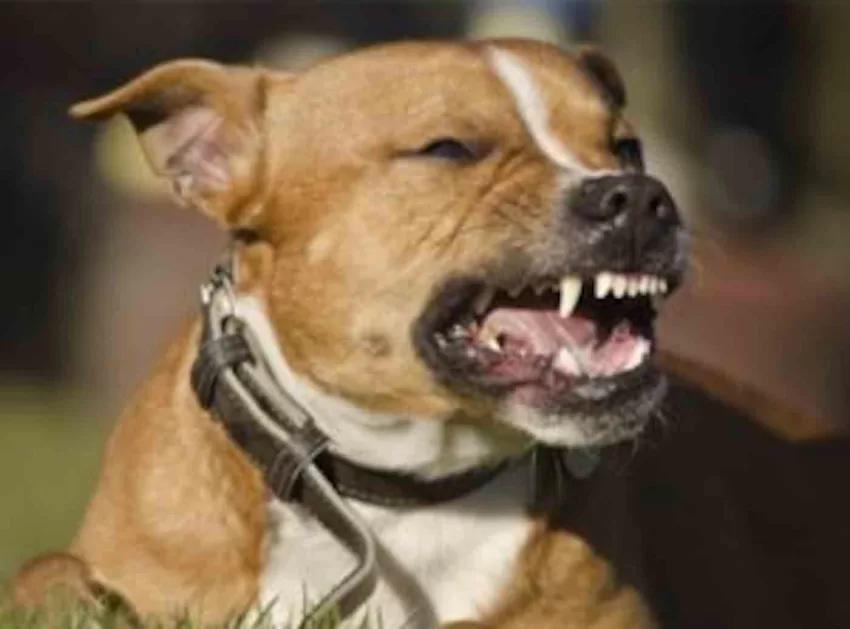
Dog Aggression, Defined
Dog aggression is defined as growling, snarling, lunging, snapping and biting. Aggressive behaviour in dogs does not often occur in every circumstance of the dog’s daily life, so it isn’t accurate to use the term “aggressive” to define a dog. Instead, the term “aggression” refers to behaviour that is often rooted in reinforced repetitions of instinctive defensive behaviour.
Aggressive behaviour in dogs occurs for a few reasons, but it never occurs out of a simple desire to dominate others or to achieve a leadership position in the family. Any dog is smart enough to know that it’s humans who control pretty much everything in his life, from food to walks to sleep patterns. No dog has a problem with this relationship.
What’s the reinforcer?
Reinforcement is defined as something that gets more of a behaviour. Dogs repeat aggressive behaviour because it gets them something that they want. This can be mere relief from a stressful situation that happens when a trigger is around.
But I don’t Punish My Dog!
Punishment is by definition is dog something that gets less of a behaviour. Correcting your dog by doing anything your dog doesn’t like and getting him to stop trmporarily is by definition, punishing your dog.
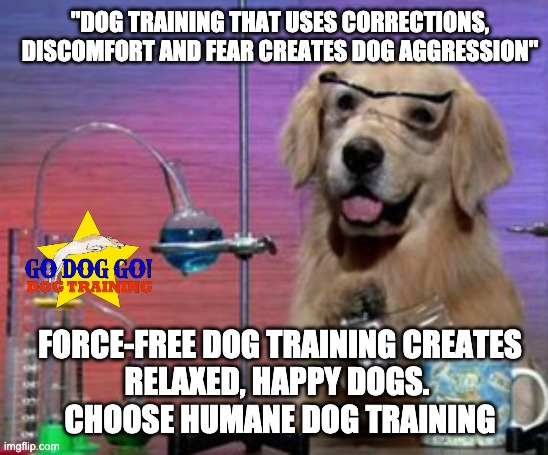
Should you ever physically or verbally correct reactive or aggressive dog behaviour?
Here are six good reasons not to correct your reactive dog’s aggression.
1. Correcting aggressive dog behaviour adds a negative association to the trigger.
Dogs can literally only think about one thing at a time. When the dog’s trigger comes into view, he is not even fully aware of you. If you verbally or physically correct the dog for his reactivity when the trigger is in view (or even shortly afterwards) he will think that the trigger caused you to become aggressive.
The dog will make the association that when his trigger comes into view, the human becomes aggressive and confusing. Something bad will happen when the trigger appears. From the dog’s perspective, he now has even more incentive than ever to seek relief from the presence of the trigger
2. Correction in the presence of the trigger adds to the dog’s anxiety about the trigger.
The dog develops a habit of feeling anxious in the presence of the trigger. Directly after a physical or verbal correction, the dog may stop barking, lunging, snarling, snapping and biting for a moment or two. All the correction has done is interrupted the behaviour.
3. Reactive behaviour will intensify when you are not there to correct the dog.
There’s no doubt that corrections interrupt and temporarily stop unwanted behaviour. However, no correction can change the emotions that cause a dog to perform a given behaviour. As a matter of fact, a correction can actually increase the likelihood of a behaviour occurring. Especially when there is little or no chance of the correction being applied. A simple analogy is speeding tickets given to drivers. A driver who has a strong inclination to drive faster than the speed limit will speed when there is no police presence. He’ll usually slow down when their radar detector picks up a radar.
An Analogy
Let’s look at a dog who barks at passersby from the comfort of his living room. A dog sees a pedestrian appear on the sidewalk. The person represents a change in the environment and could be a threat. The dog instinctively alerts and the person walks on down the sidewalk. The dog’s alert barking is reinforced by the disappearance of the potential threat. This is repeated multiple times with different people passing by.
Then one time, as he is scaring the threat away” the human of the house grabs him by the collar, gives him a little collar jerk and says “No”. The dog stops barking for a few seconds. By then the pedestrian disappears. The dog now knows the pedestrian causes the human of the house to say “no!” and jerk his collar.
The next time he is barking at pedestrians and sees the human of the house coming, he takes evasive measures and continues barking until corrected. When the human isn’t there at all, the reaction starts to include barking, lunging, and snarling.
4.The dog may make random environmental associations with corrections.
In the case of remote corrections such as from electronic collars, including citronella collars, a dog may develop a threat response to anything that’s present when the correction occurs. A dog who barks out of excitement in the car can get a shock right after he barks and he’ll stop barking at that moment. But many dogs will learn that the shock and car rides are related. And then they develop weird anxiety related to getting in the car.
5. Dogs that are trained through the use of corrections are more likely to show increased aggressive behaviour.
Since the early 21st century, at least two published studies have found that anxiety and aggressive dog behaviours increased when punitive training methods were used 1.
6. Dogs trained using corrections don’t learn as quickly as dogs trained using positive reinforcement
Positive reinforcement and training games that limit behavioral choices using management tools that prevent behavior from being practiced while rewarding the dog for desired behavioural choices help dogs to learn new behaviour quickly.
Far more quickly than dogs that are trained using aversive techniques like collar jerks or shock collars. That’s because when a dog is physically corrected, its brain starts producing a phytochemical called cortisol. Elevated cortisol levels mean the body is getting ready to defend itself or run away. When it’s in that anxious state, the brain is physically incapable of taking in any new information.
That being said, a timely physical correction can interrupt a behavior. The problem is that the dog often perceives things that were in the environment when he received the correction to be a potential threat. Because of this, some dogs will become anxious and either shut down completely (same effect as headlights have on a deer) or lash out defensively or in a preemptive bid to scare the stressor away.
If you need help teaching your dog to be relaxed and well-behaved no matter what is happening around him, please reach out to us here, or subscribe to this blog to get free information on helping your dog to get over his reactive or aggressive behavior.
Dr. Meghan Herron of the University of Pennsylvania studied dog aggression and the use of punishment. The study was published in the Journal of Applied Animal Behavior Science. The study found that using punitive techniques (defined as applying something the dog doesn’t like that stops a behaviour) when training dogs increases aggressive behaviour. It doesn’t decrease it, particularly over the long term. This study also found that most owner-directed aggression would cease after the dog owner stopped using physical corrections in training.

Very nice article. We have stopped correcting Grady when aggression is present by getting his attention and asking him to sit and look at us then ask for his paw. Is this OK?
Hi Sue,
I think you and Grady will both benefit from my newer edition of Freaked out Fido: Help for Owners of Dogs Who Flip Out. Please check your email. Thanks for your comment.
Great thanks Lynne