Use Dog Language To Up Your DogTraining Game
No matter what we’re teaching a dog, it’s crucial to be able to read dog body language. Then we can offer a visual cue as a means of letting him know what we want him to do. Obviously, inter-dog communication doesn’t use verbal language like we do. Instead, dogs communicate via complex combinations of body postures, movements, facial expressions and relatively few vocal signals.
Novice dog owners or dog trainers will often repeat a dog training command, physically manipulate their dog into position, and then give verbal praise and/or a food reward, hoping the dog will come to learn the meaning of the cue and connect it with a reward. However, from the dog’s perspective, the combination of verbal cues and physical manipulation is intense and confusing. It’s a slow way to teach a dog, especially in a world where we want things to happen now. Often the dog or puppy will resist because he really has no idea what’s going on, and his reflexes go into resist to survive mode. Some puppies may start mouthing as well. And then he’s labeled stubborn, or dominant, or alpha etc.
Dogs Are ESL Students From A Foreign Species
The truth is the dog is an ESL student from a completely foreign species. It’s kind of miraculous that a dog can figure us out at all. No other non-human species has the ability to be so connected with human beings. No other animal can pick up on our body language and facial expressions as well as a dog can. This almost uncanny ability is the result of thousands of years of following us humans and their predecessors around and figuring out ways to get us to feed, shelter and look after them. Dogs have us figured out like no other animal in the world. And for the longest time, it worked both ways.
Humans Can’t Just Let A Good Thing Be
But dog training became increasingly convoluted and often brutal, perhaps especially in the late 1900s and early 20th century when, after years of communication based dog-human relationships, it became fashionable to torture dogs into compliance with a plethora of medieval looking devices designed to make the dog uncomfortable if he didn’t read through our confusing messaging and do what he was told. It wasn’t really surprising that dog attacks on humans shot up to near epidemic levels by the end of the 20th century. Fortunately, by then, animal behaviour scientists started noticing what was happening, and the dog training world began to shift on it’s axis.
Old Becomes New Again
The beginning of the 21st century brought new light to an often dismally brutal world of dog training. By then, behaviour scientists and many dog trainers were learning that training had to change. It turned out that using a combination of positive reinforcement bases behaviour modification, learning theory principles and easy to understand communication techniques was the fastest way to train animals of any species but it worked especially well with dogs. Training the dog by engaging him and watching his body language made training fast and easy. Dog attacks on humans are far more frequent when coercive training techniques are used. Study after study has come out suggesting there is a direct correlation between aversive training methods and dog attacks on humans, including this one.
But the risk of human directed aggression isn’t the only thing that should make us think twice about using dominance based dog training. The fact is, that using aversives to train is a slow and unreliable way to train dogs. This is partly the result of the dog being physically unable to learn new things when he’s tense and worried and partly because this method doesn’t do anything to foster mutual communication between dog and human.
Human Behaviour That Creates Problem Dogs
Even when we’re trying to do the right thing, we humans can inadvertently cause training to slow down by applying pressure. Here’s a typical example:
The dog owner wants to teach their new puppy to lie down. So they say sit and gently pull the puppy’s front legs until the puppy is lying down as they repeat the word “down”. If the puppy figures it out they get praise and a treat, or even just praise, which in itself is meaningless to a puppy. From the puppy’s perspective: He does a sit, which he knows will bring a food reward. It does, but then the owner/trainer starts pulling on his front legs, which he instinctively resists, by pulling back against the gentle pressure.
As a result Puppy becomes at least slightly anxious. To the puppy, the stressful situation began when you told him to sit. So next time, he might do avoidant behaviours like sniffing around or play behaviours when the owner tells him to sit, and the down cue probably takes a long time to even register with the puppy. At best, the “down” on command becomes associated with anxiety and (reinforced) resistance.
Reinforced Behaviour Always Repeats
As dog trainers who use shaping will already know: The more any reinforced behaviour repeats, the more likely it is to reoccur in more and more exaggerated forms. Puppy may even begin mouthing and nipping in an effort to resist the pulling on his forelegs and end the training process sooner. He may eventually learn to lie down, but most likely will only do it under the duress of having the owner/trainer close by. More likely, he will become labelled as stubborn, alpha, dominant, etc. This will affect his relationship with his owner/trainer and with every subsequent cued behaviour the owner/trainer tries to teach him. Let’s just not go down that rabbit hole, shall we?
Effective Dog Training Strategies to Create Enthusiastic Dogs
Experienced dog trainers and dog owners know that the process of training any dog to lie down can be easily and quickly achieved using first reinforcing a lured (with a smelly lure) response, then reinforcing a response to a visual hand signal, and then adding the verbal cue last and reinforcing the response to the verbal cue.
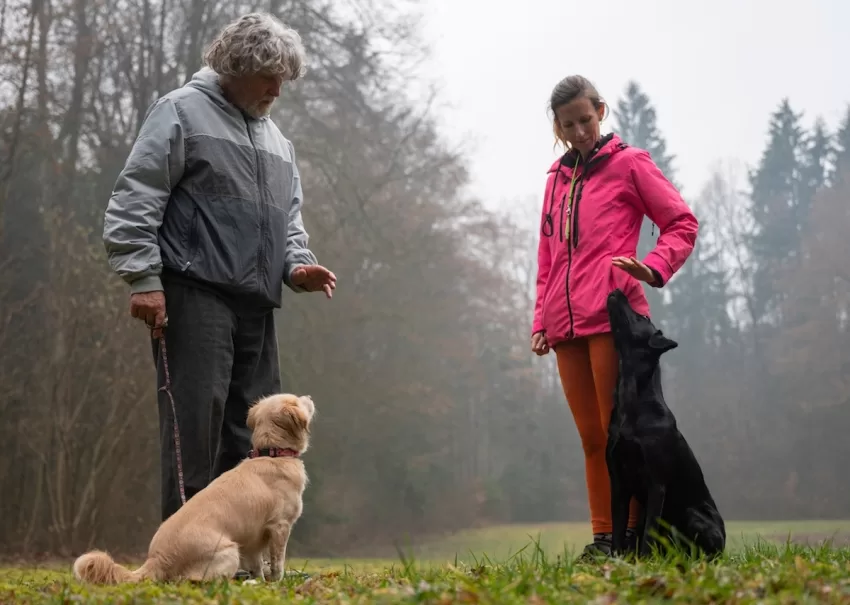
We can use visual signals as cues to quickly let the puppy what he needs to do without ever even touching him. A large part of dog language relies on visual cues, not touching (or pushing). Perhaps this is part of why animal behaviour scientist have found that puppies instinctively look for visual cues from humans. “Do this to win valuable prizes” works way faster than “do the thing or else I’ll make you do it”. Once the puppy has learned that the hand signal starts a sequence in which he can use his behaviour to win praise and a yummy treat, we can add the verbal cue. There is never any resistance unless the puppy has unmet physical needs. The puppy quickly learns that lying down on a command is a fun game that he can win.
Add a verbal behaviour cue after Puppy is already engaged. Don’t add a verbal cue until the puppy clearly knows he can use his behaviour to win praise and a yummy treat. The puppy is set up to try to learn from the owner/trainer. Stubbornness never comes into play.
Using Dog Language to Make It Easy For the Dog to Learn
Three things have to happen if we want our dogs to respond quickly and reliably to training. We need to make sure our dog’s physical needs are met and that he isn’t distracted or experiencing anxiety. That’s because a dog can’t learn if he’s distracted or experiencing anxiety. Learn to read your dog’s subtle visual dog language cues. Then pay attention so you’ll know when he’s willing and able to learn. Only when a dog is willing and able to learn, can we try to teach him something new. Communication is key here. The fastest way to train a dog is by using language that our student is already set up to learn, made up of visual signals. Once the dog learns a visual signal is a cue to perform an action, we have to make it super easy for them to learn the meanings of our verbal cues.
So be visual before you add the verbal commands. Don’t be afraid to use smelly food lures to initiate a behaviour and then transition to a consistent hand signal. You can fade the food lures just as soon as your dog is getting the gist of what you want him to do. I’ve trained thousands of dogs and they always delight me with their willingness.
There are no stubborn dogs. There are no dominant or alpha dogs. If you aren’t getting the training results you want with your dog, it’s because you aren’t communicating clearly with your dog. It’s likely you’re inadvertently practising reinforcement and repetition of behaviour you don’t want more of.
Learn more about dog language by clicking here