Dog Training Tools Matter
Just like anything else you do, if you have the right tools, training your puppy will be much easier than not having the proper equipment. Having poor quality (or wrong) tools can make training frustrating and confusing for everyone involved. Here’s a list of tools the world’s top professional dog trainers use to train their dogs. We want you and your dog to have everything you need to succeed.
1. Patience
Out of all the dog training tools you can get, Patience is the most important tool you need to train a dog. Dogs learn through repeated reinforcement. That means in order to have a well trained dog, you need to do many reinforced repetitions of every behaviour you want him to learn. If you have a puppy, you’ll always need to remember that your puppy is an infant member of a foreign species, Puppies have no way of knowing anything you want to teach them. Always keep training sessions short. If you start to grow impatient or frustrated, stop the training session on a happy note. Then take some time to assess the problem you are having communicating with your puppy. You can get back to the training session later on.
2. wide Training Pouch
Get a training pouch that you can easily get your hand into, on a belt : A Dog Gone Good Rapid Rewards pouch is definitely the best one I’ve come across. However if you can’t get one of these, Petsafe and Outward Hound also make wide pouches. Get a Rapid Rewards pouch here
3. Flat Buckle Collar
In order for your puppy to learn fast and build a trusting relationship with you, his guardian, you will need to protect him from discomfort and pain. Avoid using a chain, prong, martingale, or electronic collar. They all work on the premise allowing the dog to do the wrong behaviour and then causing some level of discomfort to your dog to make him stop. It’s a confusing method for dogs. Because of this, it often leads to subsequent anxiety related behaviour problems. Corrective collars are never necessary and you will get faster, lifelong results by setting your puppy up for success by preventing what you don’t want. Then you can reinforce what you do want with food reinforcers, praise and play.
4. Ruffwear Front Range Harness
This harness is a favourite with dog trainers, because it is really well made, comfortable for the dog, and versatile. The Ruffwear Front Range Harness has 2 leash attachment points: On the chest and on the back. They are available on Amazon.ca
5. Clicker
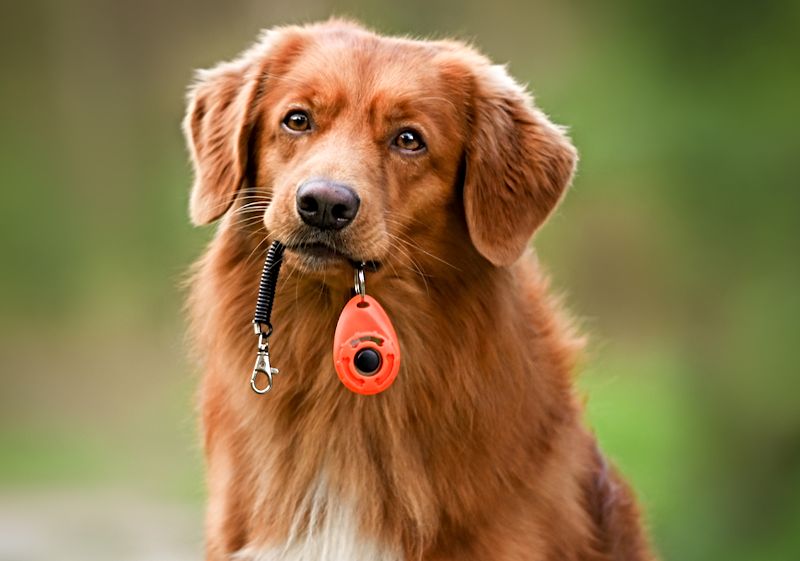
Clickers come with loud or soft clicks. If you have a confident or boisterous dog or puppy you should choose a clicker with a louder click. However, if your dog is shy or sound sensitive, choose a clicker with a softer click.
- The iClick is a soft one, suitable for sound sensitive puppies and dogs
- Box Clickers are louder and suitable for most puppies and dogs
- Star Mark Clickers have an ergonomic design and a loud click
5. Acme Dog Whistle For Teaching Recall
If you happen to have an easily distracted dog, such as an upland bird dog (pointers and Brittany spaniels), or a scent hound (coon hound, bloodhound, basset hound), a dog whistle can be a lifesaver. When we’re outdoors the sound of great whistle carries much better (especially in the forest) than a human voice. When patiently and progressively trained to come back a whistle, a dog can become very reliable off leash. Some dog whistles are much better than others. Out of the whistles I’ve tried, Acme Whistles makes the best dog-training whistles hands down. They are loud enough and pitched so that their sound can carry a long way, and with practice, even distracted dogs will listen for the sound and come running.
6. Biothane Long Line
A 30-foot biothane long line is a must-have for training a dog to:
- Come when called
- Walk nicely on a leash
- Bring items back (retrieving)
You’ll find biothane long lines at many retailers. We like them because they’re durable, lightweight, easy to clean, they’re easier on the hands than nylon or polypro. And they don’t inconveniently rot and break like cotton long lines do, leaving you with the broken end of a longline as your untrained dog runs away. It’s always better to invest in dependable equipment.
Conclusion
Whether you’re training a puppy or an older dog, having the right tools will help you on your training journey and make training your dog a fun activity that you and your dog can do together. I hope these recommendations will help you to get the best out of your training experience.